The Disneyland of Tennis: Inside the 2041 US Open
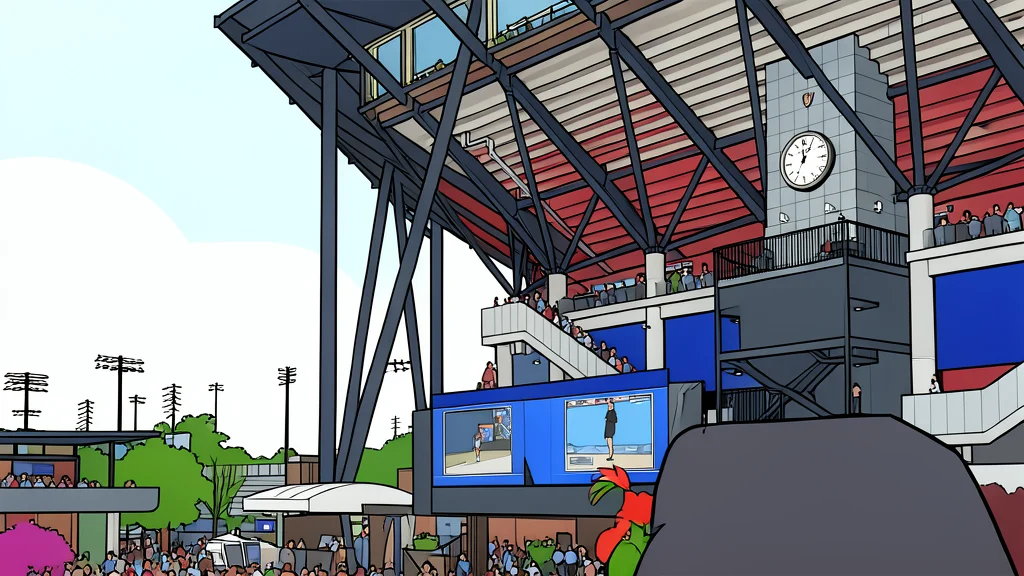
Craig Tiley’s vision for the US Open is no longer just a metaphor. In 2041, the tournament has evolved into a premiumized spectacle where access, hydration, and even eye contact with players come with a price tag.
The air in the USTA Liquid Death National Tennis Center hums with a specific frequency, the low thrum of premiumized expectation. You have cleared security, a process that now feels less like entry and more like onboarding. On Practice Court 23, Myla Rose and Leo Federer trade volleys, their movements sharp against the backdrop of a Mixed Doubles draw sponsored by Botoxxify, the tournament’s official neuromodulator partner. The geometry of the court is unchanged, but the texture of the experience has shifted beneath your feet.
In a few hours, Jake Paul, the 50th president of the United States, will arrive for opening night alongside First Lady Jutta Leerdam-Paul and Labor Secretary Dana White. Venus Williams has just accepted a wildcard, her presence a ghost of a past era in a landscape now dominated by layers of access. You stand at the precipice of paying off last year’s Honey Deuces on Klarna, the debt a physical weight in your pocket. This is the Disneyland of tennis, a phrase coined by Craig Tiley that has calcified into reality over fifteen years of incremental erosion.
Layers of Access and Premium Seating
Before you even step onto the grounds, the US Open Experience app dictates your trajectory. The choice is not merely between entry and exit, but between Grounds Pass, Grounds Pass Plus, Grounds Pass Platinum, and Grounds Pass Presented by FTX. Tennis itself is a commodity included only in the Platinum tier. For those wishing to bypass the standard queue for the escalator to the 300 level of Blackstone Court, a FastPass is required.
The FastPass+ adds another layer, an $85 premium that grants the holder the privilege of briefly making eye contact with a player. It is a transactional intimacy, a fleeting human connection monetized and packaged. The erosion of value-for-money is subtle, almost imperceptible, mirroring the gradual shifts in American life since the Airline Deregulation Act. Here, however, the shift is explicit, written into the admission tiers and the branded activations that pepper the landscape.
Viral Foods and Luxury Hydration
Thirst is a solvable problem, provided you have the funds. At the Emirates Luxury Hydration Pavilion, a bottle of water costs $31, but it arrives with a commemorative cap shaped like a miniature Anna Wintour in sunglasses. The drink is not just hydration; it is a collectible, a small trophy for the effort of consumption. Nearby, the Grey Goose Food Court serves the Mega Honey Deuce, a 96-ounce vodka lemonade in a souvenir fishbowl, garnished with six melon balls and a month of complimentary credit monitoring.
Hunger is another vector for engagement. The $55 chopped cheese sandwich from Hajji’s Blue Sky Deli, now a Wonder property, is the viral item of the year. The line moves slowly, the bread warm and dense, the cheese melted into a savory lattice. For those seeking healthier fare, an Erewhon store sits beneath Mamdani Grandstand, occupying the space vacated by Lululemon after the Great Athleisure Correction of 2037. The merch stands nearby are Fanatics Experiences, a reminder that even your clothing is part of the curated ecosystem.
Fast4 Sets and Immersive Wagering
The matches themselves have been reshaped by market research. All contests are now best-of-three Fast4 sets, a format designed for digestible content windows. The long rallies of the past are gone, replaced by rapid exchanges that fit neatly into the attention span of the modern spectator. If the final-set tiebreak feels lacking in stakes, the tournament offers immersive second-screen engagement opportunities.
Wagering, or predicting as the language now prefers, is available on everything from the next game to the likelihood of a 19-year-old qualifier double-faulting at 30-all. Craig Tiley, an early adopter of this model during his time at the Australian Open, paved the way for this integration. The courtside advertising for William Hill survived only one tournament before disappearing amid scrutiny, but the digital betting remains, woven into the fabric of the fan experience. The spectacle is no longer just on the court; it is in your pocket, in your app, in the very air you breathe.