New Tech Captures Multi-Person Motion with Smartphone Cameras
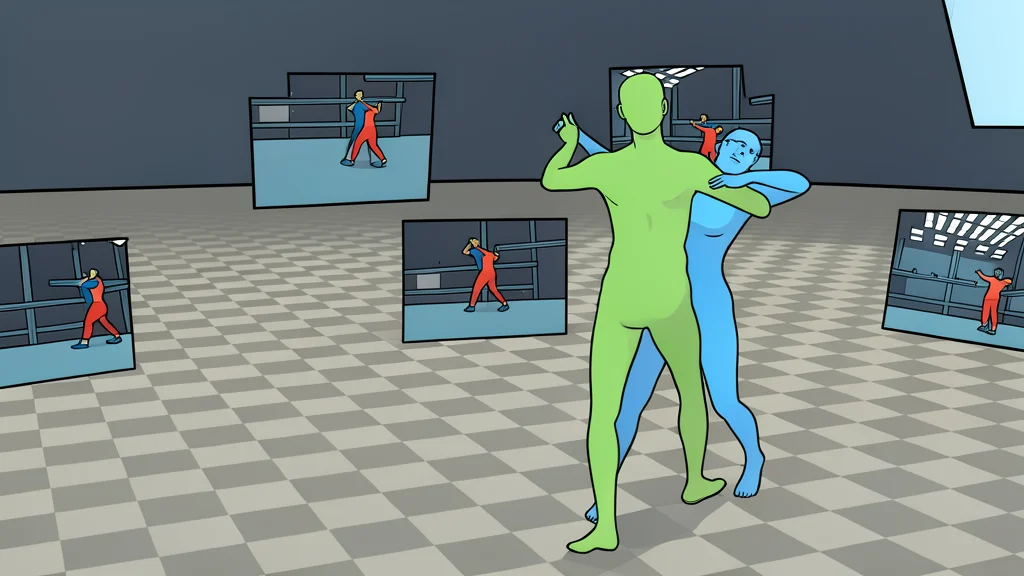
Researchers developed a system that tracks complex interactions like hugs using standard phones, eliminating the need for expensive motion capture suits.
Key points
- MAMMA achieves pose accuracy within 1 millimeter of professional marker-based systems.
- The system processes data three times faster than traditional manual workflows.
- It uses standard smartphone cameras to track complex interactions like hugs.
Researchers at the Max Planck Institute for Intelligent Systems and Carnegie Mellon University have developed a method to capture human movement without physical markers. Their system, known as MAMMA, uses standard smartphone cameras to reconstruct lifelike motion, including close interactions like hugs and martial arts moves that previously caused tracking errors in traditional setups.
For decades, accurate motion capture required actors to wear suits studded with physical markers in specialized studios. This process is expensive, time-consuming, and prone to failure when people get close, as one person can block the camera’s view of another’s markers. The new technology aims to remove these barriers by achieving similar accuracy with consumer-grade equipment.
Virtual markers replace physical gear
MAMMA works by estimating virtual markers directly on the skin of people in video footage. It fits a detailed human body model to these points, allowing the system to track 512 points across multiple camera views. This approach solves the occlusion problem where physical markers become invisible or blocked during physical contact.
According to Tech Xplore, the system was presented at the CVPR 2026 conference. The technology is designed to handle complex social interactions and physical contact, producing results that are comparable to commercial marker-based systems. It can process data nearly three times faster than the manual workflows required by traditional setups.
Accuracy rivals professional studio standards
The lead author, Hanz Cuevas Velasquez, states that the difference in pose accuracy between MAMMA and suit-based systems is less than one millimeter. This level of precision is significant because it allows for the creation of realistic digital avatars and animations without the overhead of a massive motion capture studio.
The trade-off for this convenience is reliance on computer vision algorithms rather than direct optical tracking. However, the system is robust enough to work with sets of iPhones, making high-fidelity motion capture accessible to smaller independent studios and research teams who previously could not afford professional infrastructure.
Applications in medicine and gaming
The technology has potential uses in medicine, biomechanics, and sports science. In clinical settings, it allows for patient movement tracking without intrusive gear, enabling analysis in natural environments rather than just clinical labs. Sports coaches can also use it to analyze the form of multiple athletes simultaneously without disrupting their movements.
In the entertainment industry, the system can create expressive avatars for virtual reality and capture contact-rich animations for games. This democratizes the ability to create polished character movements, reducing the dependency on expensive, specialized hardware that has historically limited access to high-quality motion data.