Artist Breaks Down the Surreal Lab Design in the Mermaid Mask
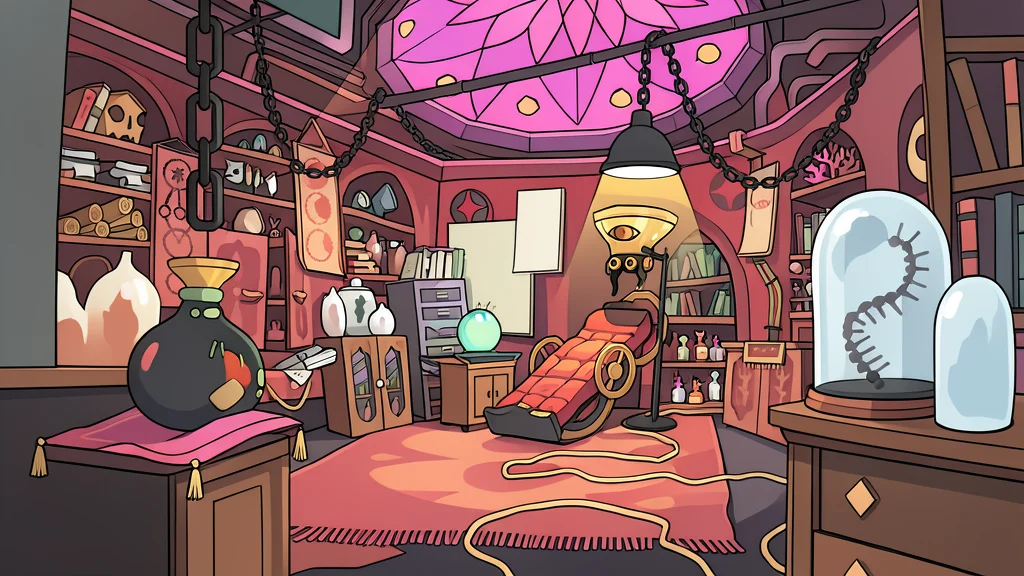
Catherine Unger explains how she balanced 18th-century aesthetics with gameplay clarity to create a unsettling dream doctor's room.
Key points
- Catherine Unger designed a surreal lab environment for The Mermaid Mask that blends 18th-century infirmary aesthetics with gothic laboratory elements.
- The artist used a pink palette and a stained-glass dome to create a dreamlike atmosphere, contrasting it with sinister objects like skulls.
- Techniques such as offset outlines and leading lines were used to balance visual richness with the readability required for point-and-click gameplay.
Creating a background for a point-and-click adventure game requires more than just pretty pictures; it demands a rigorous balance between artistic vision and functional gameplay. Catherine Unger, the artist behind a key environment in SFB Games' new release The Mermaid Mask, recently detailed her process for designing a room that feels like a hybrid of an 18th-century infirmary, a cabinet of curiosities, and a gothic laboratory. As reported by Creative Bloq, the goal was to craft a space that is rich enough to explore but clear enough to navigate without visual noise.
The specific scene in question belongs to a doctor who experiments on dreams, a concept that drove the visual direction. Unger introduced a surreal stained-glass dome to act as a giant dreamcatcher, which also served as the catalyst for the room’s distinctive pink color palette. This choice created a dreamlike atmosphere that contrasts sharply with the darker, more sinister elements found on the shelves, establishing a tone of unsettling intrigue that is central to the Detective Grimoire series.
Balancing Artistry With Gameplay Clarity
The primary challenge in this workflow is ensuring that every interactive element is readable and supports the story without being overly obvious. Unger notes that this requires significant planning and iteration to align the artwork with the practical needs of the player. The environment must feel rich and detailed, inviting close examination, yet it cannot become so complex that it obscures the objects the player needs to find. This tension between aesthetic complexity and functional simplicity is a defining feature of point-and-click game design.
To manage this, the artist relies on a homogeneous color palette to help flatten the visual hierarchy, preventing the scene from feeling chaotic. She uses subtle color accents to guide the viewer’s eye to key areas, ensuring that the most important interactive items stand out against the background. This approach allows the room to feel dense with detail while remaining easy to process at a glance, a crucial trade-off for maintaining player engagement.
Techniques For Adding Depth And Definition
Unger employs several specific techniques to give her digital paintings a traditional, hand-drawn quality. One method involves creating offset outlines by duplicating shape layers and adding a stroke with zero fill. This simple trick adds definition to the artwork and helps it feel less like a flat digital render. Additionally, she applies textured layers with low opacity to nearly every surface, breaking up smooth gradients and adding a tactile richness that enhances the overall immersion.
Leading lines are another critical tool in her kit. The arrangement of shelves, the pattern of light and shadow, and even the sprawling wires and rug on the floor all serve to pull the player's attention toward the focal point of the scene. These visual cues bridge the gap between the foreground and background, reducing visual clutter and reinforcing the scale of the room. By carefully directing the eye, the artist ensures that the player naturally discovers the story elements in the intended order.
Creating An Unsettling Atmosphere
The final goal was to make the room feel inherently unsettling, a mood achieved by juxtaposing a soft, fruity color palette with classic sinister imagery such as skulls and chains. Unger framed the scene with dark foreground shelves, a visual trick that makes the viewer feel as though they are intruding upon a private space. This sense of intrusion is key to the narrative, suggesting that the player has stumbled upon something they perhaps should not have seen, thereby deepening the mystery of the doctor’s experiments.