Fruit Fly Brain Map Learns to Play Doom and More
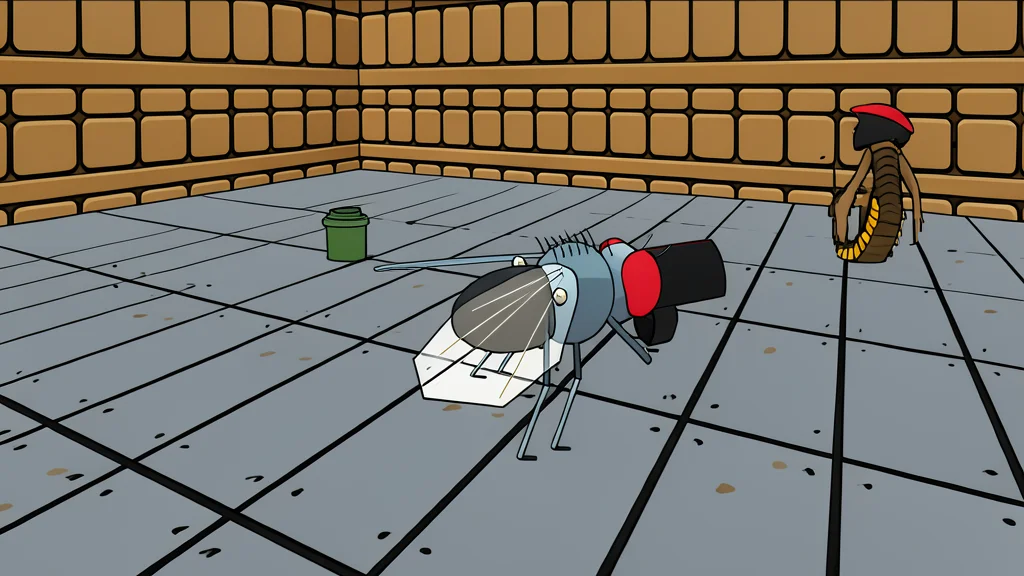
A new simulation uses a detailed map of a fly’s nervous system to learn video games, offering unique insights into neural mechanics while raising questions about the limits of biological computation.
The list of unusual platforms capable of running the classic 1993 shooter Doom has grown by one more entry: a simulated fruit fly brain. This latest development stems from a high-resolution map of a male Drosophila’s nervous system, released by Google in partnership with HHMI Janelia Research. The mapping project documented 166,000 neurons and 11,700 distinct types, setting a new record for the most complex neural structure ever visualized.
While the primary goal of this research is to help neuroscientists understand how brain structure relates to function, the data has found an unexpected audience in the gaming community. Software engineer Alex Wormuth used the map to build a virtual replica of the fly’s brain and programmed it to learn how to play Doom. The experiment demonstrates that even a tiny insect’s neural architecture can process visual inputs and generate motor outputs, albeit with significant computational overhead.
Simulating Neural Responses to Visual Input
The technical process behind making a fly brain play a shooter is surprisingly intricate. Every frame of the game generates thousands of brightness and color data points, which are fed into the simulated neural network. This network contains 25.6 million connections, mirroring the complexity of the real insect. As the game progresses, these inputs activate specific neurons, which in turn determine the controls the simulated fly executes. This loop repeats every frame, creating a continuous feedback cycle between visual perception and action.
The simulation also accounts for pain and reward. When the virtual fly takes nonfatal damage, the system triggers specific dopamine receptors known as PPL101. In real fruit flies, these receptors regulate hunger and aggression. By linking game damage to these biological pathways, the simulation attempts to mimic the emotional and physiological responses that drive behavior in living organisms. This adds a layer of biological realism that standard artificial intelligence systems typically lack.
Expanding Beyond Doom to Other Games
Doom is not the only game being taught to this simulated brain. Other developers have created similar setups to train the fly’s neural network on different titles. Jessica Paquette has set up a version to learn Super Mario 64, while researcher Lyra Bubbles has applied the same technique to Beat Saber. These varied applications show that the underlying neural map is versatile enough to handle different types of gameplay, from platforming to rhythm-based challenges.
The community has also pushed the boundaries into more abstract tasks. One user taught the simulation to navigate an escape room, while another had it play soccer. Some have even gone as far as giving the simulated brain a small amount of Bitcoin to trade, or having it deploy a cryptocurrency token. These experiments highlight the curiosity-driven nature of the tech community, which often uses serious scientific data for playful and unconventional purposes.
Scientific Value and Computational Trade-offs
According to GN technics/gaming, the long-term impact of this work will likely be felt in neuroscience rather than gaming. Understanding the precise structure of the brain allows scientists to better understand the mechanisms behind brain function. The ability to simulate these structures and observe how they process information provides a powerful tool for research. However, running these simulations requires significant computational power to handle the massive number of connections, which is a trade-off for the biological accuracy.
For readers, the takeaway is that complex biological systems can be modeled and simulated to perform tasks far removed from their natural environment. While a fruit fly brain playing Doom is a novelty, the techniques used to achieve this offer a glimpse into how neural networks process information. The catch is that these simulations are expensive to run and primarily serve as educational or research tools rather than practical computing solutions. Yet, they provide a unique window into the mechanics of intelligence, even in the smallest of creatures.