Humanoid Robots Target the Night Shift Labor Gap
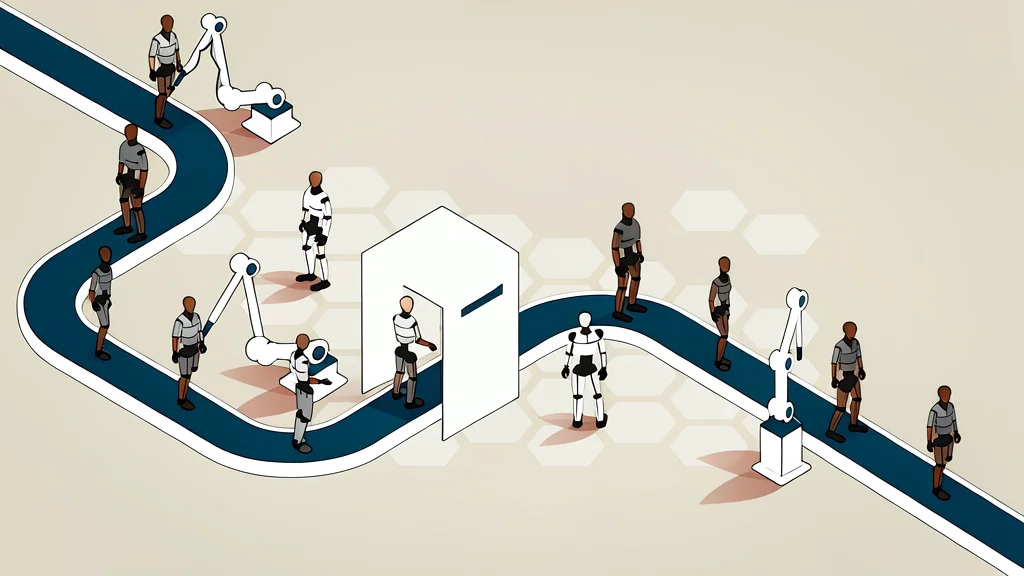
New financial analysis suggests that automated workers could soon undercut human wages in factories, addressing a growing crisis in manufacturing staffing.
The debate over humanoid robots is shifting from science fiction to balance sheets. While industry leaders often cite massive long-term market projections, a recent analysis by JPMorgan offers a more immediate metric: hourly operating costs. The bank estimates that running a humanoid robot in a warehouse or factory environment could cost around ten dollars per hour. This figure is significantly lower than the roughly thirty dollars per hour required to employ a human worker for similar tasks, creating a compelling economic argument for automation in sectors facing severe labor shortages.
The primary driver for this shift is a structural gap in the American manufacturing workforce. JPMorgan calculates that hundreds of thousands of jobs are currently unfilled, with projections suggesting this deficit could expand to 1.6 million positions by 2030. In this context, the cost savings of robotics are not just a bonus but a necessity for companies that cannot find enough human hands to handle repetitive physical tasks. The technology is being deployed specifically where these shortages are most acute, turning a staffing crisis into an opportunity for mechanical labor.
Productivity Gaps Remain Significant
However, the financial advantage is not yet a clean win. Current models indicate that a humanoid robot is less efficient than a human worker in terms of output. JPMorgan estimates that it currently takes two robots to match the production volume of one person. When factoring in the lower hourly cost, two robots operating at ten to twelve dollars per hour result in a total cost of twenty to twenty-four dollars. This is cheaper than the thirty dollars for a human, but the margin is tighter than the raw hourly wage comparison suggests. The trade-off is clear: companies save money, but they must deploy more machines to achieve the same throughput.
The outlook for this efficiency gap is improving. By 2030, the bank predicts that technological advancements in dexterity and intelligence will reduce the ratio to roughly 1.2 or 1.3 robots per human equivalent. At that point, the effective labor cost could drop to between twelve and sixteen dollars per hour. This narrowing gap is expected to be the tipping point that makes humanoid adoption economically unavoidable for large-scale manufacturers, rather than an experimental novelty.
Factories Serve as the Testing Ground
Manufacturing plants are the ideal starting environment for this technology because they offer predictable conditions. The floors are stable, the tools are designed for human hands, and the tasks are repetitive enough to allow for reliable training and measurement. Major automotive companies are already using these sites to test the limits of robotic capability. For instance, BMW has deployed humanoid units in its Spartanburg plant to move components and support vehicle production. These robots have logged thousands of hours of real-world work, demonstrating that they can safely perform precise, repetitive duties alongside human crews.
The tasks are becoming more complex as the hardware improves. Early deployments focused on simple material handling and moving parts between workstations. Newer generations of robots are now being asked to handle more variation, such as picking unsorted components and organizing them into the correct sequence for assembly. This progression from simple transport to complex manipulation is critical. It moves the technology from a niche solution for heavy lifting to a general-purpose tool for the factory floor.
Major Automakers Scale Production Plans
The commitment to this technology is moving beyond pilot programs. Hyundai has announced plans to manufacture up to 30,000 humanoid robots annually by 2028. These units, based on the Boston Dynamics Atlas platform, are intended for gradual introduction into factories and warehouses. The initial focus will be on parts sequencing and logistics, with plans to expand into more complicated assembly work as reliability improves. Similarly, Meta is exploring the use of robots in its data centers to handle equipment movement and server resets, reducing the need for humans to work in hot, noisy, and controlled environments.
These deployments signal a shift in how companies view labor costs. The source of this trend, GN auto tech/robotics, highlights that the first mass market for humanoids is not the home, but the industrial sector where the math is most straightforward. By targeting jobs with known hourly costs and chronic staffing shortages, manufacturers are finding a way to integrate automation without overhauling their entire operational structure. The result is a gradual, but steady, replacement of human labor in the most difficult-to-fill positions.