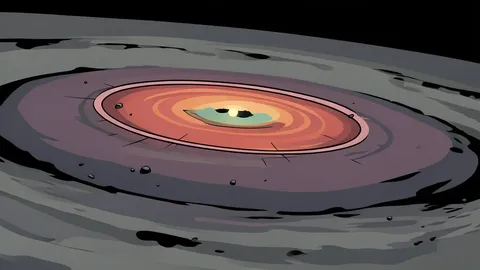
LHC Data Rules Out Another Zone for Quantum Black Holes

New analysis of Large Hadron Collider data finds no trace of tiny black holes, narrowing the search for quantum gravity effects.
Key points
- UCSB physicists found no evidence of microscopic quantum black holes in Large Hadron Collider data.
- The result establishes an exclusion limit, ruling out specific theories involving extra dimensions.
- The study also validated a new technique for detecting rare particles in high-energy collisions.
Researchers at the University of California, Santa Barbara, have analyzed data from the Large Hadron Collider to search for microscopic quantum black holes. The investigation found no evidence that these exotic objects were produced during the machine’s high-energy collisions, effectively closing off another potential avenue for discovering new physics.
While the absence of a detection might seem like a dead end, physicists describe it as a crucial exclusion limit. By ruling out specific scenarios, the study sharpens the parameters within which quantum gravity effects could still exist, providing a clearer roadmap for future experiments aimed at unifying fundamental forces.
Narrowing the search for gravity
The search targets a long-standing puzzle in physics: the vast gap between the scale of the visible universe and the Planck scale, where quantum gravity is expected to dominate. Some theories suggest that extra spatial dimensions could make gravity significantly stronger at extremely tiny scales, potentially allowing black holes to form in particle collisions. As reported by ScienceDaily, this new result eliminates a specific range of those possibilities, forcing theorists to look elsewhere for evidence of such dimensions.
Why missing particles matter
In particle physics, failing to detect a particle is a valid scientific result that provides genuine knowledge about the universe. Tamas Vami, a researcher in the Compact Muon Solenoid experiment, noted that had they found evidence, it would have allowed for direct study of quantum gravity. Instead, the null result serves as a boundary, telling scientists exactly where these hypothetical objects do not exist under the tested conditions.
This approach mirrors historical scientific progress, where periods of missing data often lead to radically new frameworks. By systematically eliminating theoretical possibilities, the team helps determine where future experiments should focus their energy and resources, ensuring that the search for a unified theory of physics remains efficient and targeted.
Testing new detection techniques
Beyond the specific search for black holes, the study served as a practical test for a new technique designed to identify rare and previously unknown particles. The researchers used this method to scan through trillions of proton-proton collisions, demonstrating its utility in filtering out background noise. This technical advancement is valuable for the broader particle physics community, as it improves the sensitivity of future searches for other elusive phenomena.