Mars Moon Mystery Hinges on Stickney Crater Data
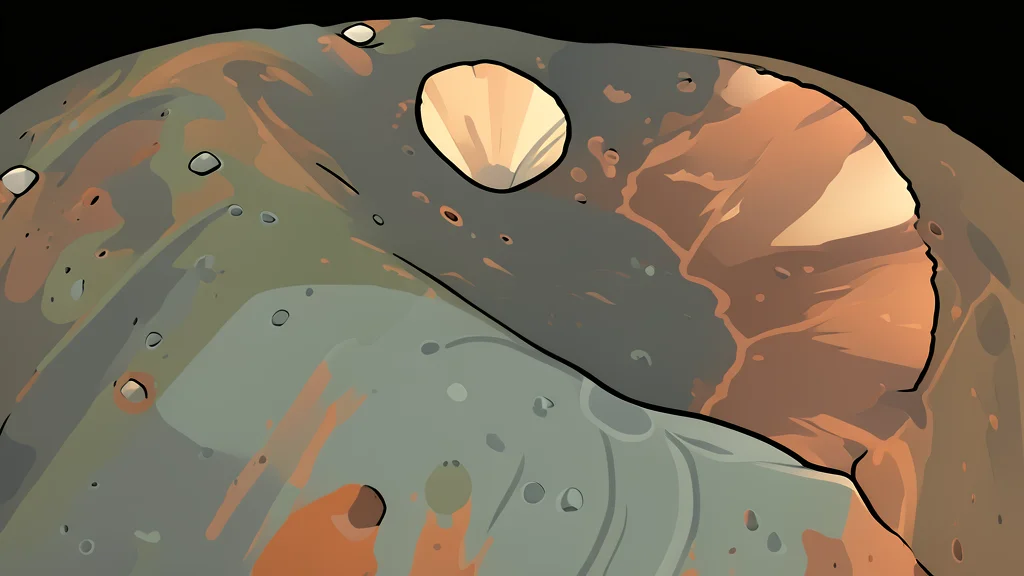
A massive crater on Phobos may hold the key to whether the moon is a captured asteroid or debris from an ancient impact on Mars.
The origin of Mars' innermost moon, Phobos, remains one of the most persistent puzzles in planetary science. Scientists are divided on whether this irregular body is a captured asteroid or the leftover debris from a violent collision that struck the red planet billions of years ago. The answer may lie hidden beneath the surface of its largest feature, Stickney Crater.
Recent research presented at the European Geosciences Union assembly in Vienna suggests that mapping the moon's internal density could resolve this long-standing debate. As reported by ScienceDaily, these new models indicate that the impact that formed the crater may have compressed material into a dense pocket, offering a physical fingerprint of the moon's birth.
Crater Age Determines Moon Origin
The timing of the Stickney impact is the critical variable in this equation. If Phobos formed from debris ejected by a giant impact on Mars, the crater likely dates back approximately 4.2 billion years. Conversely, if the moon was originally an asteroid captured by Mars' gravity, the collision that carved the crater would be much more recent, occurring around 2.6 billion years ago.
Distinguishing between these two timelines requires understanding how mass is distributed inside the moon. Current estimates suggest Phobos has a porous interior that may contain water ice. However, knowing whether there is a concentrated region of denser material beneath the crater is essential for determining which formation scenario is correct.
Surviving a Giant Impact
The existence of such a massive crater on a small body raises a significant physical question. An impact large enough to create a scar nine kilometers in diameter should theoretically shatter a moon of Phobos' size. Researchers propose that the moon survived because it likely has a very low and uniform density, allowing it to absorb the shock energy like a sponge.
This structural resilience implies that Phobos is not just a random rock in orbit, but a body with specific internal properties that have allowed it to endure extreme events. Understanding these properties is crucial for explaining how a small moon could withstand a force that should have destroyed it.
Upcoming Mission Will Test Theories
Theoretical models can only go so far without physical evidence. Japan’s upcoming MMX sample return mission is expected to provide the concrete data needed to settle the debate. By collecting and analyzing material from the moon, scientists hope to verify the presence of compressed layers and confirm the internal structure predicted by recent studies.
Until that data is available, the origin of Phobos remains a matter of educated inference. The trade-off for the scientific community is a continued reliance on indirect measurements of gravity and motion, which offer clues but lack the definitive proof that physical samples can provide.