Humanoid Robot Race Shifts from Hardware to Data Advantage

A new benchmark suggests that pre-training on broad human behavior matters more than specific task practice for general-purpose robots.
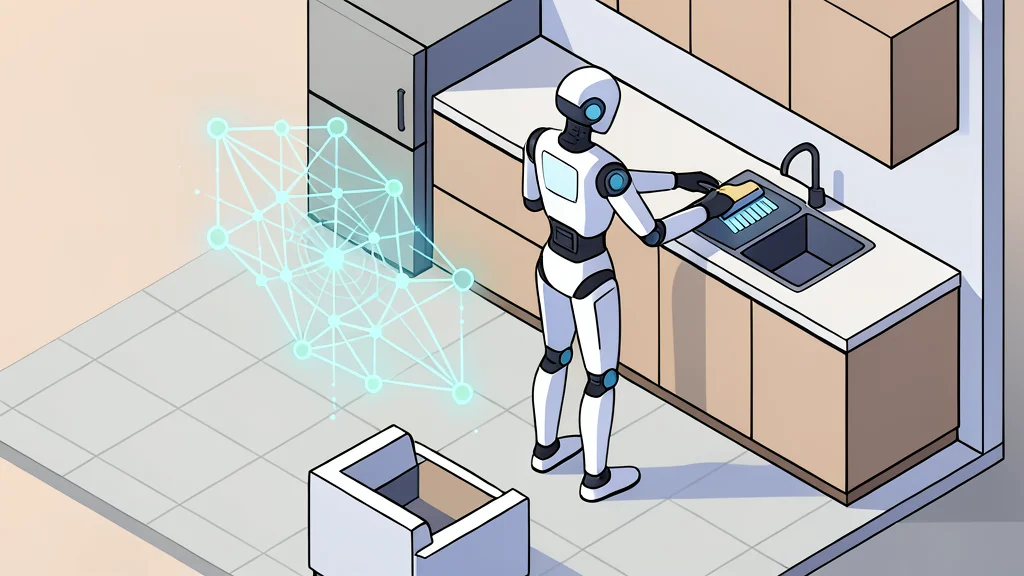
The competition for general-purpose humanoid robots is shifting away from who can build the strongest motors to who can teach machines to understand how humans move. Figure AI recently reported that its latest model, Helix 2.5, successfully completed household chores in thirty homes it had never visited. The key finding was not that the robot performed perfectly, but that it performed significantly better than an identical model that lacked a specific type of foundational training. This suggests that the ability to generalize from broad human experience is becoming the primary differentiator in the field.
Figure AI claims its approach offers a measurable advantage over starting from scratch. In blind tests where robots had no prior data on the specific environments, a model trained with their 'Index' dataset succeeded in 56% of trials. An otherwise identical model trained without this pre-training managed only 9%. This gap highlights that the robot’s ability to handle unfamiliar situations depends heavily on the quality of the behavioral data it absorbed during its initial learning phase, rather than just its physical hardware.
Pre-training creates a measurable performance gap
The term 'zero-shot' in this context does not mean the robot learned the tasks without any training. Instead, it means the specific homes, objects, and layouts were new to the model during the test. The robot had to rely on general knowledge of how people navigate spaces and manipulate objects. Figure’s data shows that this general knowledge, derived from observing human behavior, allows the machine to handle novel environments with far greater reliability than a model that relies solely on specific task instructions.
This approach challenges the assumption that robots need to be fine-tuned for every specific environment. By ingesting large volumes of human movement data, Figure is building a 'physical intelligence' that transfers across different contexts. The company is currently generating significant amounts of new behavioral data daily and has committed substantial compute resources to refining this model. This strategy aims to create a robot that can adapt to any home without needing a site-specific setup.
Tesla relies on automotive data for robotics
Tesla’s Optimus project takes a different path to the same goal. The company is leveraging its massive fleet of vehicles, which continuously collect real-world data on navigation and perception. Tesla believes that the neural networks trained on billions of miles of driving data contain relevant insights for general-purpose robotics. This creates a potential data moat, as Tesla already possesses the infrastructure to process and utilize these large-scale datasets for its humanoid robot development.
However, the trade-off is that automotive data is focused on driving, not on the fine-grained manipulation of objects like folding towels or making beds. Figure is explicitly collecting data on how humans interact with physical objects in domestic settings. For Tesla investors, the critical question is whether the data advantage from its car fleet translates effectively into the specific dexterity required for household tasks. The source GN auto tech/robotics notes that while Tesla has the scale, Figure is targeting the specific behavioral gap that remains.
Generalization remains the primary hurdle
Despite the impressive 56% success rate, Figure’s results indicate that the problem is far from solved. More than four out of ten trials still failed, meaning the robot was still unable to complete basic chores in nearly half of the new environments. The evaluation also covered only a limited set of household behaviors. Scaling this capability to a wide variety of tasks and environments will require significant further development.
The ultimate metric for both companies is not just task completion, but the rate at which new training data improves the robot’s ability to handle unseen situations. If Tesla can translate its automotive data advantage into similar generalization capabilities, it could match or exceed Figure’s progress. The race is now defined by which company can build the most efficient loop for converting raw human experience into reliable robot behavior.