A Seven-Hour Space Flash Rewrites the Rules of Stellar Collapse
A record-breaking gamma-ray burst has forced scientists to rethink how massive stars die, revealing a rare mechanism that leaves a distinct observational signature.
Astronomers have confirmed the detection of a gamma-ray burst that lasted for seven hours, a duration that shatters previous records for this type of cosmic event. The signal, designated GRB 250702B, outshone the brightest stars in the sky and persisted for approximately 25,000 seconds. This extraordinary length provides a rare window into a specific and violent phase of stellar evolution that is otherwise difficult to observe.
Gamma-ray bursts are among the most energetic explosions in the universe, typically associated with the death throes of massive stars. While short bursts are common, long-duration events like this one are rare and often dimmer, making them challenging to detect with conventional telescopes. The confirmation of this specific signal offers a new data point for understanding the complex physics of collapsing stellar cores.
A rare helium merger scenario
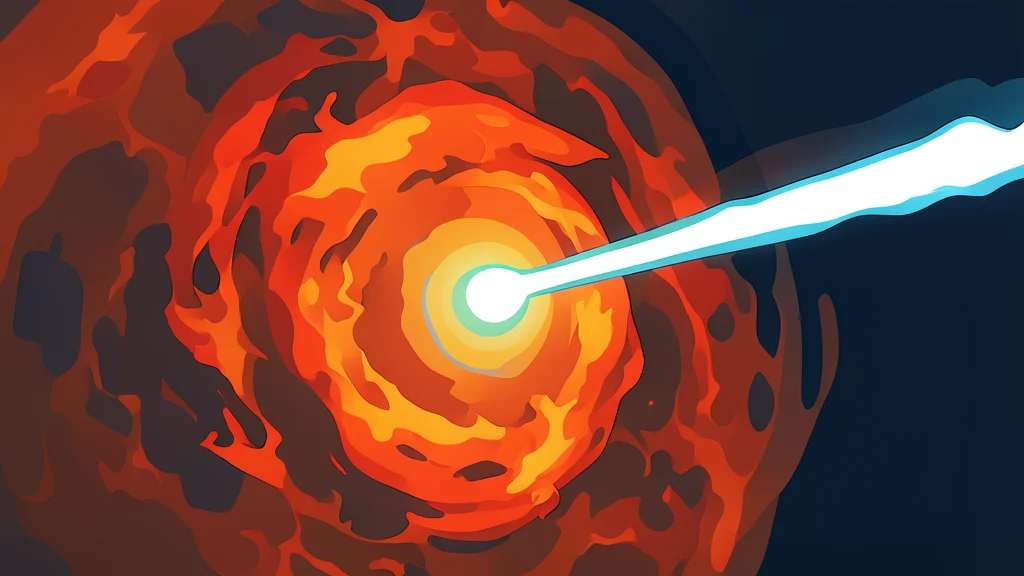
Standard models suggest that most gamma-ray bursts result from the collapse of a massive star into a black hole or the merger of two neutron stars. However, the specific characteristics of GRB 250702B point toward a different mechanism. Researchers believe the event was caused by a stellar-mass black hole consuming a stripped helium star from the inside. This unusual interaction creates a long, sustained release of energy that distinguishes it from typical supernovae.
The helium star in this scenario has lost its outer hydrogen layers, leaving behind a dense core of helium. As the black hole devours this material, it generates a powerful jet of radiation that escapes the star's core. This process explains the extended duration of the burst, as the fuel source is consumed slowly over hours rather than minutes. Identifying this specific type of merger helps refine models of how black holes grow in the early universe.
Detection challenges and historical context
Detecting these long-duration bursts is a technical challenge because they are often fainter and less distinct than their shorter counterparts. Space telescopes must monitor broad areas of the sky continuously to catch these fleeting events. The discovery adds to the historical record of gamma-ray bursts, which were first identified accidentally by US military satellites in the 1960s during the Cold War. Since then, our understanding of these phenomena has evolved significantly.
As reported by GN technics/space (en-US), the identification of this event relies on precise timing and spectral analysis. Scientists use multiple instruments to cross-reference data, ensuring that the signal is of astrophysical origin and not a local interference. The ability to distinguish between different types of stellar collapses is crucial for building a comprehensive map of cosmic evolution and the life cycles of massive stars.
Future telescopes will improve observation
Current limitations in telescope sensitivity mean that many long-duration bursts likely go undetected. To address this, preparations are underway for the launch of the COSI telescope in 2027. This new instrument is designed specifically to detect and analyze long-duration gamma-ray bursts with greater precision. By improving our observational tools, scientists hope to find more examples of helium merger events and validate the theoretical models that explain them.
The trade-off for this improved detection capability is the need for significant computational resources and data processing power. As we look further back in time, these rare events become increasingly important for understanding the formation of the first black holes. The seven-hour burst serves as a critical benchmark, proving that such long-lived energy releases are possible and observable. This discovery underscores the need for continued investment in space-based observatories to uncover the hidden history of the cosmos.