UN General Assembly 2026: Iran Conflict Dominates New York
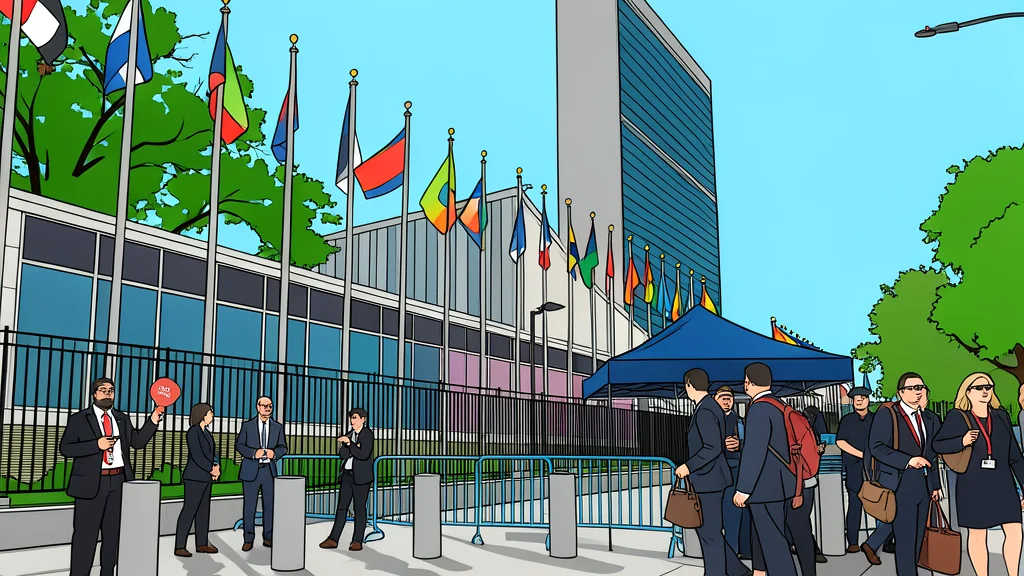
Leaders gather in New York as US-Iran tensions and Houthi actions in the Red Sea reshape the diplomatic agenda.
Key points
- US President Trump and Iranian President Pezeshkian are scheduled to address the UN General Assembly on consecutive days.
- Yemen's Houthis have expanded control near the Bab el-Mandeb Strait, while Iran restricts shipping in the Strait of Hormuz.
- Chinese and Russian leaders will not attend in person, with Xi Jinping expected to meet Trump separately in Washington.
World leaders are converging on New York City for the United Nations General Assembly, an event increasingly defined by the escalating conflict between the United States, Israel, and Iran. According to Middle East Eye, the gathering is overshadowed by strategic disputes that have moved beyond the Gulf, raising significant concerns about global energy security and economic stability.
President Donald Trump is scheduled to address the assembly early Tuesday, returning to the podium a year after claiming US strikes had significantly damaged Iran’s nuclear capabilities. This time, he faces a skeptical international audience as Tehran responds by restricting shipping through the Strait of Hormuz, a critical artery for global energy supplies. The tension is further compounded by the rapid expansion of Yemen’s Houthi influence along the Red Sea coast, where they have captured territory overlooking the Bab el-Mandeb Strait, another vital chokepoint for international trade.
Diplomatic Divisions and Absent Leaders
The assembly comes at a time when the UN is struggling to maintain its centrality in global diplomacy, with several major powers opting to skip the event. Chinese President Xi Jinping, who last participated remotely in 2021, will not travel to New York; instead, he is expected to hold bilateral talks with Trump in Washington. Russian President Vladimir Putin, absent for over a decade, is sending his foreign minister, while leaders from India, Germany, and South Africa are also represented by delegates rather than heads of state.
Iranian President Masoud Pezeshkian is set to speak on Wednesday, offering Tehran a platform to challenge Washington’s narrative of the conflict. This follows closely on the heels of Trump’s address, creating a direct confrontation between the two administrations before the same international body. The US ambassador, Mike Waltz, indicated that the president would focus on confronting complex global problems and ensuring Iran does not acquire nuclear weapons.
Palestine and Regional Humanitarian Crises
The war in Gaza remains a central, though contentious, feature of the summit. Israeli Prime Minister Benjamin Netanyahu is scheduled to address the assembly on Thursday, despite being the subject of an arrest warrant for alleged war crimes. In a striking divergence, Palestinian President Mahmoud Abbas will not attend in person for the second consecutive year due to a US ban on Palestinian officials. The Trump administration cited Palestinian efforts to internationalize the conflict as the reason for the denial of entry.
The General Assembly has voted to allow Abbas to participate via video link, a compromise that underscores the diplomatic tensions surrounding the issue. Diplomatic sources indicate that high-level meetings on a two-state solution and the ongoing humanitarian crisis in Sudan are also planned on the sidelines, although significant breakthroughs are not anticipated given the current geopolitical climate.
Economic Risks and Strategic Chokepoints
The strategic dimensions of the conflict are driving fears of further disruption to the world economy. The restriction of shipping in the Strait of Hormuz and the Houthi control of areas near the Bab el-Mandeb Strait threaten to destabilize supply chains that rely on these narrow waterways. Analysts suggest that the combination of military posturing and economic coercion is altering the calculus for global energy markets and trade routes.
As the week-long session progresses, the focus will remain on how the international community responds to these escalating pressures. The absence of key leaders and the competing narratives from Washington and Tehran suggest that the assembly will serve as a stage for rhetorical confrontation rather than immediate de-escalation. The coming days will test the resilience of existing diplomatic frameworks in the face of such pronounced strategic shifts.