Amateur Spots 25km Impact Crater in Quebec Wilderness
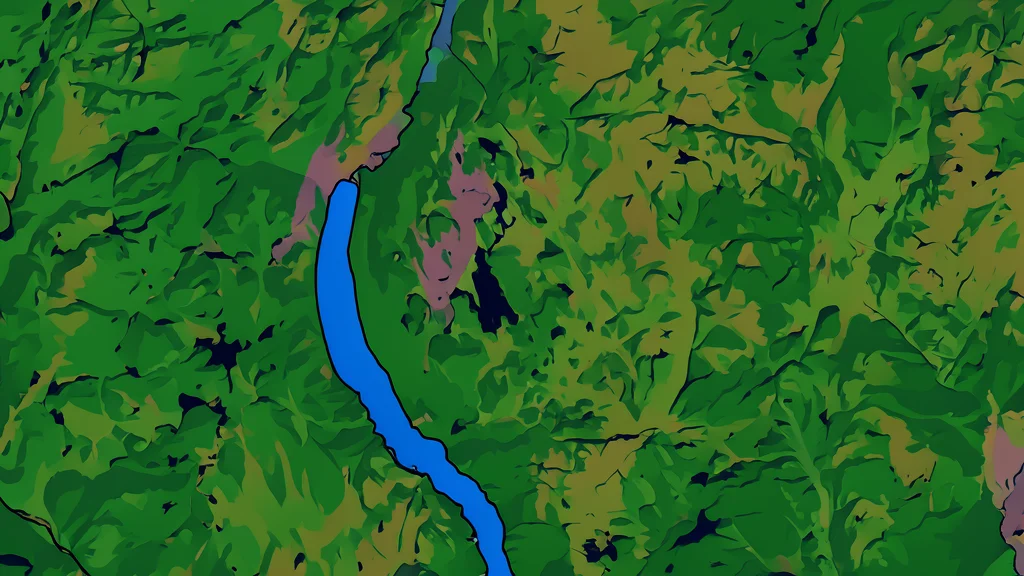
A camping search led to the discovery of a 390-million-year-old crater in remote Quebec, confirmed by unique rock formations.
Key points
- An amateur astronomer identified a 25-kilometer-wide impact crater in Quebec by analyzing satellite imagery.
- Researchers confirmed the site's origin by finding shatter cones, ruling out previous volcanic theories.
- The crater is estimated to be 390 million years old, predating a known increase in Earth's impact frequency.
A casual search for a camping spot in Quebec’s remote north has revealed a massive geological secret. An amateur astronomer noticed a circular depression on satellite maps that turned out to be a previously unrecognized impact site. The discovery adds a new entry to the global list of confirmed impact structures, which currently numbers around 200.
The site, now named Uhackatik, is approximately 25 kilometers across. It was formed roughly 390 million years ago when an asteroid struck Earth. This finding is significant because it predates a known increase in impact frequency by about 100 million years, offering a new data point for planetary scientists.
Accidental discovery leads to expedition
Joël Lapointe first noticed the circular feature near Lake Marsal while planning a trip to the Côte-Nord region in 2024. He contacted specialists who initially dismissed it, but the curiosity persisted. This prompted a team of researchers to organize a field expedition to verify the site’s origin.
The journey to the site was arduous. The team had to wade through 50 meters of water after their floatplane landed short of the shore. The landscape was dense with vegetation and swamps, making navigation difficult. Researchers noted that the environment was among the most challenging they had encountered in years of fieldwork.
Rock evidence confirms impact origin
Previous geological surveys had misidentified the area as a volcanic diatreme. However, the expedition team found shatter cones in multiple rock outcrops. These structures form only under the extreme pressures of an impact event. Their presence provided definitive proof that the crater was not volcanic in origin.
The impact was powerful enough to create a complex structure with a central uplift and high cliffs. According to planetary geologist Gordon Osinski, a similar event today would cause regional devastation and global climate effects. The confirmation of this site helps refine our understanding of impact history on Earth.
Context for planetary scientists
The discovery was reported by ScienceDaily and highlights how remote areas still hold geological secrets. The crater’s age places it in a period before a known spike in impact events. This timing may be linked to collisions within the asteroid belt, offering clues about the solar system’s past dynamics.
The name Uhackatik was chosen in consultation with the Innu Council of Ekuanitshit. This collaborative approach ensures the site is respected by local communities. The finding underscores the value of combining local knowledge with scientific investigation to uncover new geological features.