Ultraviolet Light Reveals the Hidden Mechanics of Jupiter's Storms
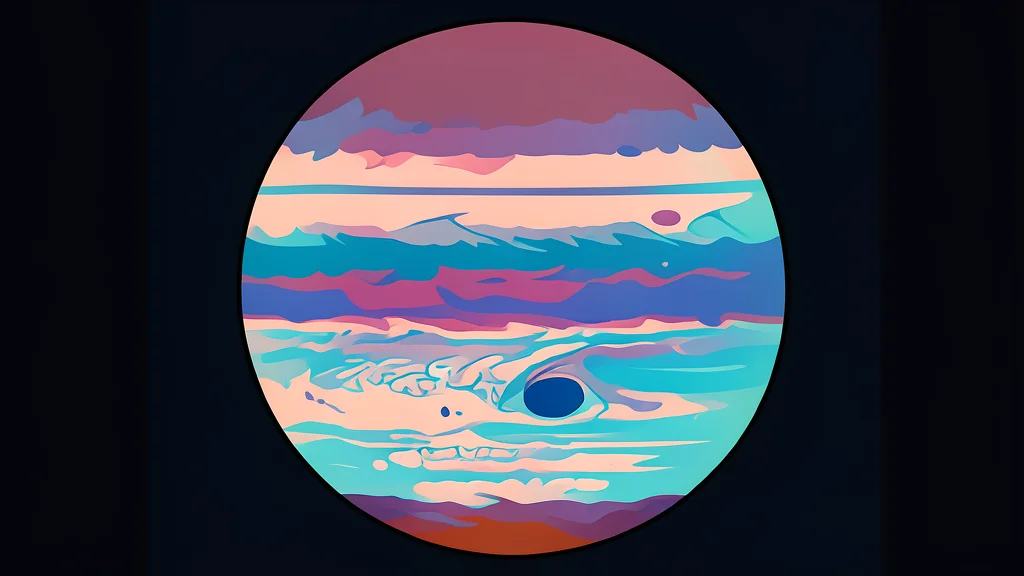
A new Hubble image shows Jupiter in ultraviolet light, turning the Great Red Spot blue and exposing how high-altitude haze shapes the planet's weather systems.
The Hubble Space Telescope has provided a striking new perspective on Jupiter by capturing the gas giant in ultraviolet light. This image, taken to mark the planet's opposition in November 2023, presents a view that is radically different from what is visible to the human eye. In this false-color rendering, the familiar bands of the planet take on a psychedelic hue, while the iconic Great Red Spot appears blue rather than red. This shift is not an error but a direct result of how specific atmospheric particles interact with light at these shorter wavelengths.
According to NASA, the blue appearance of the Great Red Spot in ultraviolet is caused by high-altitude haze particles that absorb light at these specific frequencies. The same process explains why the polar regions appear dark and muddy in the image. These areas absorb less light due to variations in particle size, composition, or altitude. By observing Jupiter outside the visible spectrum, astronomers can distinguish features that are otherwise hidden by the planet's complex cloud layers, offering a clearer map of its atmospheric structure.
Seeing beyond visible light
The human eye is limited to a narrow band of the electromagnetic spectrum, which restricts what we can observe in the universe. Astronomers use various wavelengths, including ultraviolet, to access data that is invisible to naked observation. This technique allows scientists to study the composition and behavior of atmospheres in detail. For Jupiter, a world defined by its lack of a solid surface, understanding the layers of gas and ice is critical to knowing how the planet functions. As reported by GN technics/space, this method transforms a blurry, colorful ball into a diagnostic tool for planetary science.
The trade-off of using false-color ultraviolet images is that they do not represent the planet as it would appear to an observer. Instead, they are a scientific visualization where colors are assigned to specific data points. For instance, the 'blue' of the Great Red Spot is not a reflection of blue light but an indicator of absorption by haze. This requires viewers to interpret the image as a map of atmospheric properties rather than a photograph. It is a necessary step in translating raw spectral data into a coherent understanding of planetary weather.
Mapping the deep cloud structures
One of the primary goals of studying Jupiter with tools like Hubble and NASA's Juno probe is to understand what lies beneath the visible cloud tops. The planet is a turbulent, stormy world where deep water clouds form the foundation of its weather systems. The ultraviolet image is part of a broader project to analyze these superstorm systems. By mapping the distribution of haze and clouds, scientists aim to define the three-dimensional structure of the atmosphere. This helps explain how energy is transferred from the planet's interior to its outer layers.
Understanding the gas giant's dynamics
Jupiter’s atmosphere is not a static feature but a dynamic system driven by internal heat and solar radiation. The differences in light absorption seen in the ultraviolet image provide clues about the altitude and composition of different cloud layers. This information is crucial for modeling the planet's long-term climate and storm behavior. While the image may look artistic, its value lies in its precision. It reveals the hidden architecture of a world that is fundamentally different from our own, driven by forces that continue to shape its vast, swirling bands.