China Deploys Four New Radar Satellites for Real-Time Data Processing
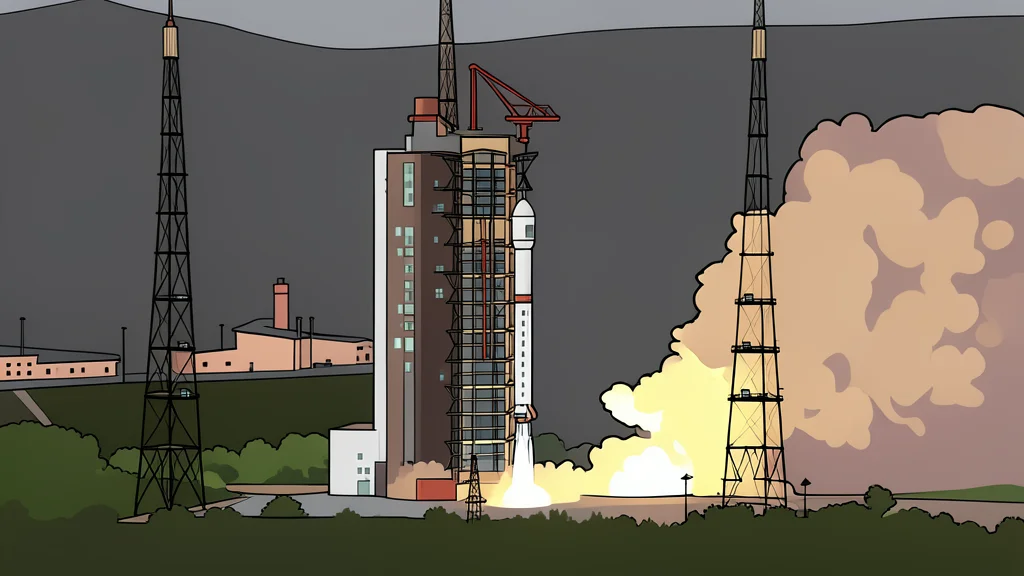
A private Chinese company has placed four advanced satellites into orbit, enabling on-board data analysis to reduce the burden on ground communication links.
China launched a Long March 2D rocket from the Taiyuan Satellite Launch Center on Saturday evening, successfully placing four radar satellites into their designated orbits. The mission, conducted by GalaxySpace, a private Beijing-based firm, marks a significant step in the company’s growing fleet of independently developed space assets. The launch took place at 6:50 pm local time in northern Shanxi province, adding to a busy schedule of space activities for the country this year.
The primary value of these new satellites lies in their ability to process data in space rather than transmitting raw information to Earth. According to GalaxySpace, the satellites are equipped with high-resolution synthetic aperture radars and intelligent on-board processing systems. This capability allows them to filter, preprocess, and extract essential information while in orbit, which significantly speeds up response times for users who need remote sensing data.
On-board processing reduces ground link pressure
Traditionally, satellites transmit large volumes of raw data to ground stations, where heavy computational resources are required to process the information. This approach creates a bottleneck, often referred to as data backhaul pressure, which can delay the availability of useful insights. By shifting this processing to the satellite itself, the system alleviates the load on communication links. Duan Xiao, the chief designer of GalaxySpace’s radar satellites, noted that this method improves overall efficiency and allows for faster request response speeds.
The trade-off for this efficiency is the increased complexity of the satellite hardware. Equipping a spacecraft with sufficient computing power for real-time analysis requires robust engineering and careful thermal management. However, GalaxySpace reports that multiple satellites in their current fleet have already demonstrated the ability to handle large-scale data processing in orbit, suggesting that the technology is mature and reliable for operational use.
Rocket specifications support precise orbital insertion
The Long March 2D rocket, manufactured by the Shanghai Academy of Spaceflight Technology, is a workhorse for such missions. It uses liquid propellants to generate a liftoff thrust of 300 metric tons. The vehicle is designed to place a payload of up to 1.2 tons into a sun-synchronous orbit at an altitude of 700 kilometers. This specific orbital configuration is ideal for radar satellites because it ensures consistent lighting conditions and allows the satellites to pass over the same part of the Earth at the same local solar time each day.
China’s space activity continues to accelerate
This latest deployment brings GalaxySpace’s total count of independently developed satellites to 53, with more than 10 of them dedicated to synthetic aperture radar technology. The launch is part of a broader trend in China’s space sector, which has now conducted 69 space launches this year. According to GN auto tech/space: space launch, the increasing frequency of these missions reflects a growing capacity for both government and private entities to access space resources.
As the number of satellites in orbit grows, the ability to manage data efficiently becomes a critical factor for operational success. The move toward on-board intelligence represents a shift in how space-based assets are utilized, prioritizing speed and bandwidth conservation. For users requiring timely remote sensing data, these capabilities could prove essential for applications ranging from environmental monitoring to disaster response.